> For the complete documentation index, see [llms.txt](https://learn.w3.io/llms.txt). Markdown versions of documentation pages are available by appending `.md` to page URLs; this page is available as [Markdown](https://learn.w3.io/the-next-evolution/quickstart.md).
# Programmable Intelligence
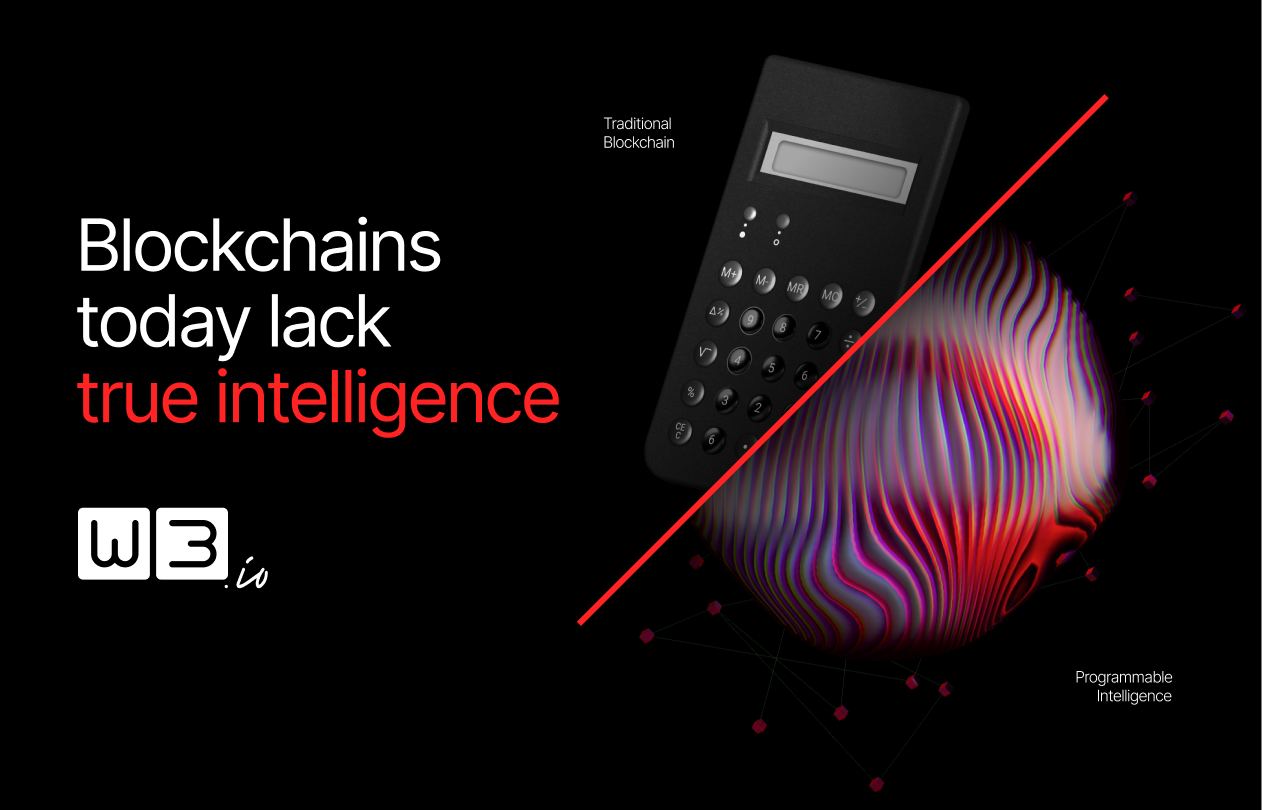
Blockchains today are powerful but not very smart. They rely on rigid smart contracts that can only follow preset rules and basic oracles that simply bring outside data onto the blockchain without verifying or acting on it. This makes blockchains passive and limited. They can store and execute transactions, but they can’t adapt, think, or automate complex decisions on their own.
To truly unlock the next era of Web3 and gain mass adoption, blockchains need programmable intelligence—they must be able to reason, verify, and execute complex logic autonomously without relying on centralized intermediaries.\
\
W3.io is spearheading **PIE (Programmable Intelligence Economy)** a new movement within Web3 focused on making blockchains smarter, more programmable, and capable of handling complex decision-making and execution.
By increasing the intelligence of blockchains, PIE doesn’t just enhance existing capabilities — it expands the total addressable market (TAM) for all of Web3, making the "pie" bigger for everyone.
### **PIe enables innovations such as:**
* **Multi-Agentic Workflows**
* Autonomous AI agents collaborating, executing, and optimizing tasks across decentralized networks without human intervention.
* **RWA (Real World Assets)**
* Tokenized real-world assets with smart, programmable automation for seamless on-chain management and verification.
* **AI-Powered Smart Contracts**
* Self-learning, adaptive contracts that process real-world data, optimize execution, and evolve autonomously.
* **Intelligent Intents**
* Programable intents that enable automation and complex use cases between and within ecosystems.
* **Decentralized Data Sharing**
* Open, trustless data flows where users control, share, and monetize information while optimizing and customization\